Built in North Carolina. Trusted Nationwide.
If you want laser cutting services that deliver accuracy, speed, and American-made reliability, US Metal Crafters is the partner you call.

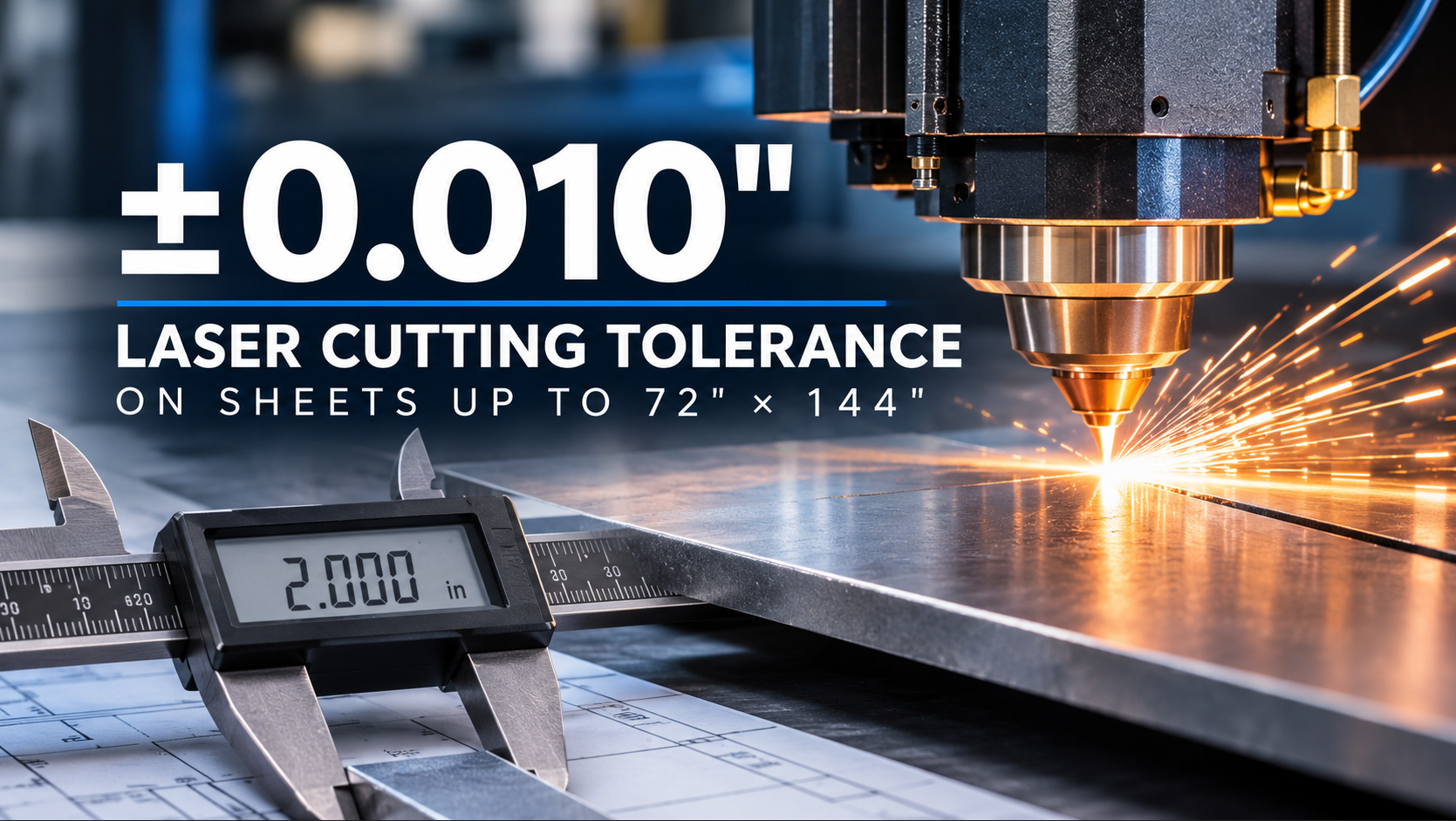
"Precision fabrication" appears on almost every metal shop's website. It doesn't tell you anything. Precise compared to what? Measured how? Held across how much of the sheet? Here's ours: ±0.010" laser cutting tolerance on sheets up to 72" × 144". That's a number. You can put it on a drawing, inspect against it, and reject a part that misses it. That's the difference between a claim and a spec.
Ten thousandths of an inch is a little thicker than two sheets of copy paper stacked together. A cut feature specified at 2.000" will measure between 1.990" and 2.010". Holes land where the drawing says. Slots and tabs line up. Edges are straight enough that the next operation doesn't have to compensate for them.
The second half of the spec matters as much as the first. Holding tolerance on a small test coupon is easy. Holding it across a full 72" × 144" sheet is the real test, because material flatness, heat, and machine accuracy all have more room to add up over a long cut path. When a shop quotes a tolerance without saying over what size, ask.
A laser cut is rarely the last step. The blank gets bent, welded, coated, and assembled, and every one of those steps inherits the accuracy of the cut. When the cut is off, it shows up as:
• Flanges that come out long or short — because the bend line landed in the wrong place on the blank.
• Poor weld fit-up — gaps the welder has to fill, or parts forced into a fixture, adding heat, distortion, and time.
• Hole patterns that drift — so hardware doesn't line up and someone on your assembly line reaches for a drift punch.
• Stacked error across assemblies — small deviations on several parts that add up to a big one at final fit.
• Rework after coating — the most expensive time to discover a dimensional problem, because the finish has to be redone too.
Small errors at the cut become large errors at assembly, and assembly is the most expensive place to find them.
1. Accepting "tight tolerances" without a number.
An adjective can't be inspected. Get the tolerance in writing, and make sure it's the one your drawing actually needs.
2. Not asking what sheet size the tolerance applies to.
A tolerance held on small parts may not hold on full-size sheets. If your parts are large, confirm the tolerance covers them.
3. Specifying the cut in isolation.
The cut tolerance should be considered alongside bending and welding. A tight cut followed by a loose forming process still produces a loose part.
4. Skipping first-article verification.
A tolerance claim means little without a first-article check against the model. Ask how the first part off the machine is measured.
5. Over-tolerancing features that don't need it.
Not every edge needs ±0.010". Calling tight tolerances on non-critical features can add cost without adding function. Save them for the features that drive fit.
6. Splitting cutting and forming between shops.
When the cut happens in one building and the bend in another, nobody owns how the two tolerances interact. Problems show up as fit-up issues no one wants to claim.
A tolerance is only as good as the system that verifies it. Our three lasers cut material up to 1" thick at up to 200 inches per minute, and their parts go through a four-step quality verification process:
• Operator checks at the machine, against the drawing.
• 3D/planar scanning on first-article parts, comparing the physical part to the model.
• Real-time KPI tracking during production, so drift shows up while the run is still going.
• Multi-tier sign-off, from the operator through a dedicated QAPM to the GM. (Learn more about our QAPM resources.)
Because cutting, forming, welding, and finishing happen in the same building, the first-article scan isn't just a cutting check. It tells the forming and welding departments what they're working with before the run continues.
Here's a simple test for any vendor's capability page: replace every adjective with "how much?" "Tight tolerances": how tight? "High precision": measured how? "Large-format cutting": how large, and at what tolerance? If the answers aren't on the page and the sales rep can't give them on the phone, the adjective is doing a job a number should be doing.
If fit and assembly matter on your part, ask any laser cutting vendor for three things: the tolerance they'll hold, the maximum sheet size it applies to, and how they verify it on first articles. We'd rather publish the number and let you hold us to it.
Want the full numbers? Contact Us to review a drawing with our engineering team.
• The Ultimate Guide to Laser Cutting (Resource)
• Two Great Things That Go Great Together–Laser Cutting and Press Brake
• Every Shop Says "One Roof." Ask for the Tolerance Report.
