Built in North Carolina. Trusted Nationwide.
If you want laser cutting services that deliver accuracy, speed, and American-made reliability, US Metal Crafters is the partner you call.
Four inspection checkpoints. 3D scans on first articles. Sign-off from the GM, not just the operator.
Every shop says it has a quality process. Say it enough times and it stops meaning anything. “We take quality seriously” shows up on nearly every fabricator's website, right next to “full-service” and “state-of-the-art.” None of it tells you what actually happens to your part between the raw sheet and the shipping dock.
Here's what happens to ours four checkpoints, one part, no skipped steps.
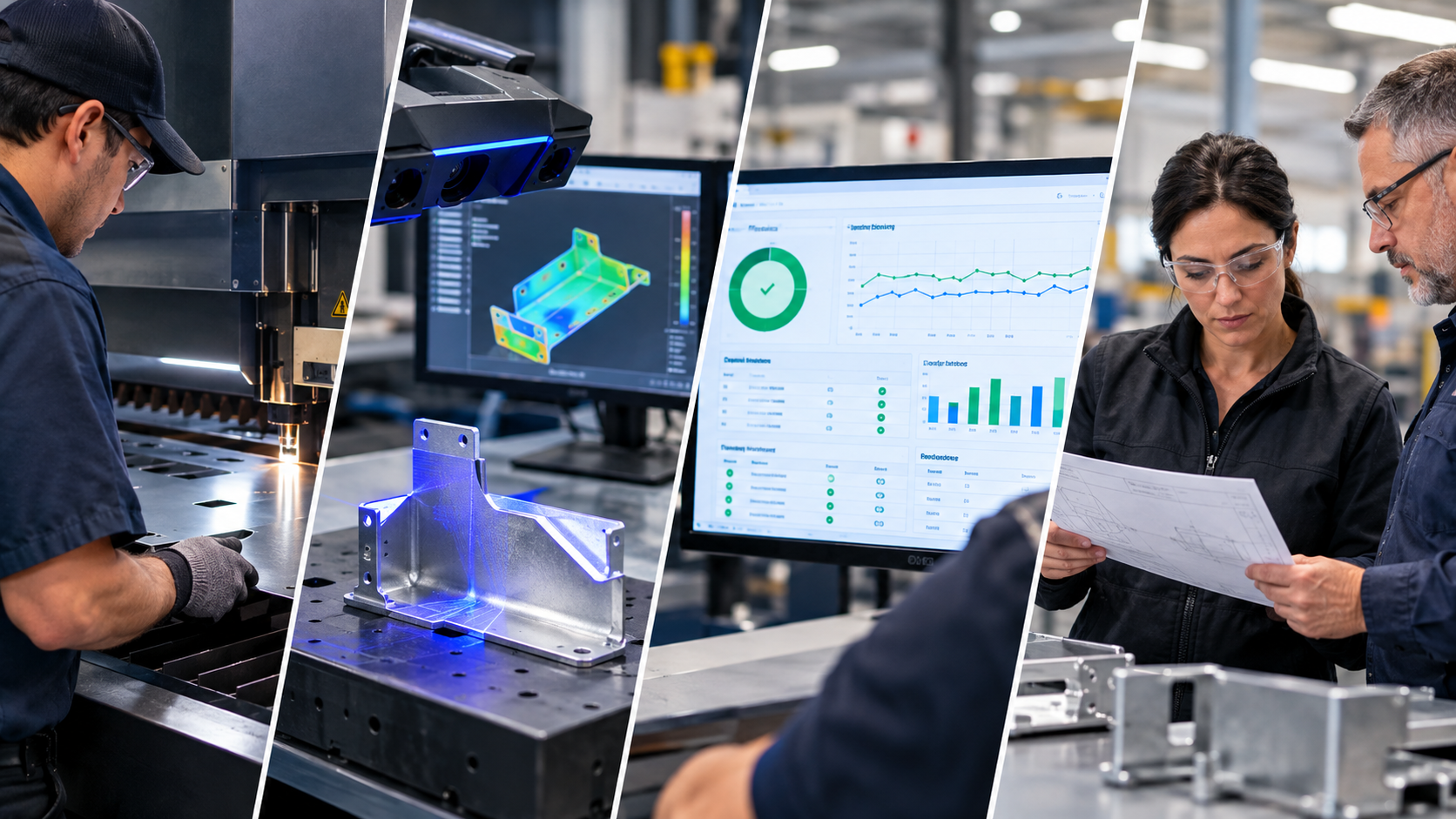
The first check happens at the machine, not after it. The person running the laser, the press, or the brake is checking work against the print in real time — not waiting for the end of a run to find a problem. That sounds obvious until you consider the alternative: a lot of shops treat inspection as something that happens downstream, after a batch is already cut, formed, or welded. By then, a bad setup has already produced ten, fifty, or five hundred parts that need to be scrapped or reworked. Catching drift at the operator level is the cheapest place in the whole process to catch it.
Before a job runs at volume, the first part off the line gets scanned — 3D and planar scanning, checked against the CAD model dimension by dimension. This is where a print tolerance either holds or it doesn't, and we find out before it matters. If a fixture is off by a few thousandths, or a bend angle is drifting from the model, the scan catches it on part one. Production doesn't proceed on the rest of the run until the first article passes. That's the difference between finding a problem on one part and finding it on a pallet.
Data doesn't wait for a weekly report. Tolerances, cycle times, and defect rates get tracked as the job runs, so drift gets caught while it's still a small problem instead of a batch-wide one. This is the part of quality control that's easy to claim and hard to actually run — it requires tracking numbers on the floor in real time, not compiling them after the fact. When a metric starts trending the wrong way mid-run, that's a signal to check the setup before it becomes a nonconformance report.
Multi-tier checks run from operator through QAPM — our Quality Assurance Program Manager, a dedicated in-house quality rep assigned to your account. On jobs that call for it, sign-off goes all the way to the GM. Not a rubber stamp. A second set of eyes with the authority to stop a shipment if something doesn't check out, even under schedule pressure.
A single inspection point — usually final QC — is where most shops put all their quality effort, because it's the cheapest to implement and the easiest to describe on a capabilities sheet. The problem is that by final inspection, all the cost of a bad part has already been spent: material, machine time, labor, shipping delays. Four checkpoints spread that same effort across the process, so problems get caught closer to where they start, not at the end where they're most expensive to fix.
Four checkpoints. One part. Every time. If your current vendor's quality process is a paragraph on their website, ask them to walk you through it checkpoint by checkpoint — who checks what, and at what point in the process. Ours is what's above. It’s detailed and the foundation of how we deliver parts to specification to our customers, Every Time. And we'll be glad to walk you through it in as much detail as you want.
