Built in North Carolina. Trusted Nationwide.
If you want laser cutting services that deliver accuracy, speed, and American-made reliability, US Metal Crafters is the partner you call.
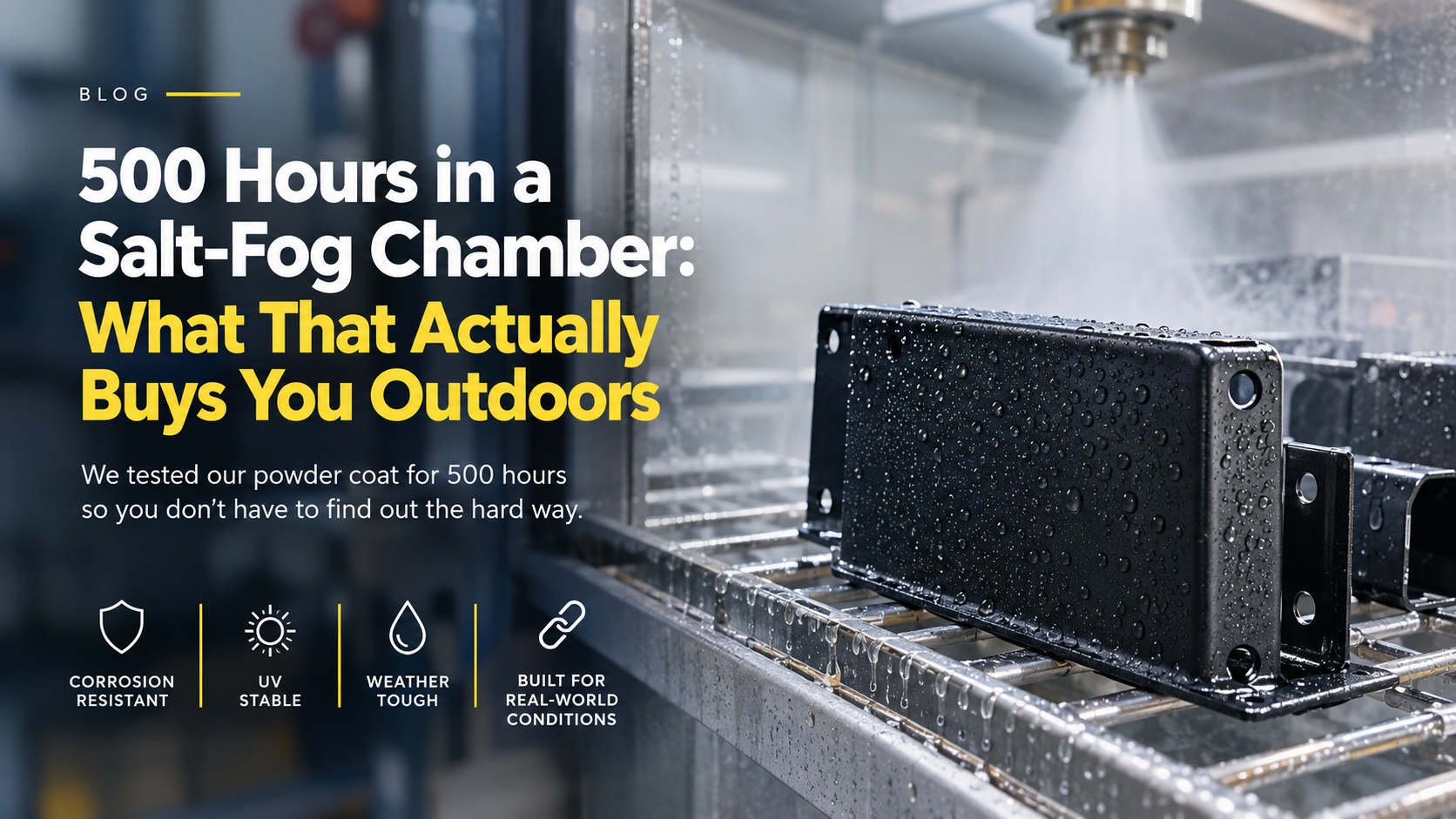
We tested our powder coat for 500 hours so you don't have to find out the hard way.
“Built to last” is not a spec. It's a feeling. Here's the spec: 500 hours in a salt/fog spray chamber, tested per customer requirement, on our in-house powder coat finish.
A salt-fog chamber accelerates the kind of corrosion a part sees over years outdoors — humidity, salt exposure, temperature cycling — compressed into a controlled test. Parts go in, get exposed to a continuous salt spray environment, and come out evaluated for coating breakdown, blistering, and corrosion creep from any scribe or edge. 500 hours is a serious duration in that world. It's the difference between “we think this will hold up” and “we ran the test and here's the result.”
For parts that sit exposed — enclosures on a data center pad, brackets on infrastructure, housings on an oil & gas platform — the failure mode that matters isn't day one. It's year three, when coating starts to break down and corrosion finds the seam. A generic “powder coating” line item doesn't tell you anything about that timeline. A salt-fog test result does, because it's a proxy for exactly the kind of slow degradation that a part sees in the field, compressed into a test you can run and measure before the part ever ships.
This matters most at the edges — literally. Corrosion doesn't usually start in the middle of a flat panel. It starts at a cut edge, a weld seam, a fastener hole, anywhere the coating has to work hardest to stay intact. A coating system that's only ever been checked on a flat test panel in a lab doesn't tell you much about how it holds up at those vulnerable points. A 500-hour test on production parts does.
Most of our competitors will tell you they offer powder coating. Fewer will tell you how it was tested, for how long, and against what standard. A vendor who can't produce a test result isn't offering proof — just a claim with nothing behind it. If a spec sheet says “weather-resistant” without a test duration attached, that's a word doing the job a number should be doing.
If corrosion resistance matters on your project — and for data center, infrastructure, or oil & gas applications, it usually does — ask any vendor for their actual salt-fog test results: duration, substrate, and what “pass” meant in that test. That's a fair, specific question, and it's one we can answer with documentation, not adjectives.
We didn't run this test to put a number in a brochure. We ran it because a part that fails outdoors doesn't fail quietly — it fails on-site, on your customer's schedule, not ours, usually well after the invoice has been paid and the original vendor conversation is long over.
