Built in North Carolina. Trusted Nationwide.
If you want laser cutting services that deliver accuracy, speed, and American-made reliability, US Metal Crafters is the partner you call.

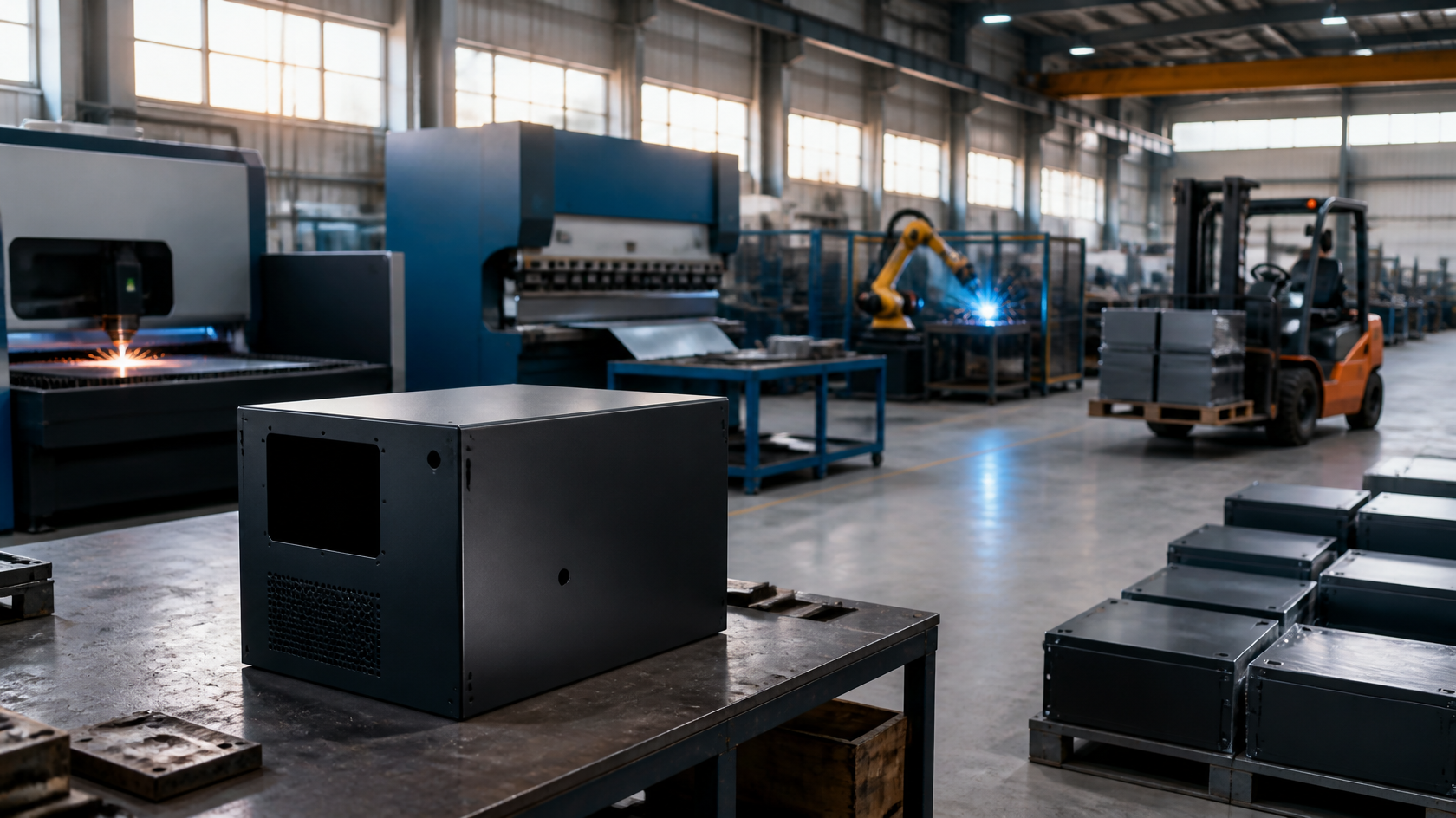
Here's a common supply chain for one fabricated enclosure: a laser shop cuts the blanks, a second shop bends and welds them, a third powder coats, and someone (often your own team) handles hardware and final assembly. Four purchase orders. Four schedules. Three truck trips before the part ever reaches your line. On paper, each vendor's quote looks competitive. The cost that doesn't appear on any of those quotes is the cost of coordinating them. That's the one worth adding up.
Every handoff between shops adds three things: a queue, a truck, and a boundary of responsibility. Parts finish at the laser shop, wait for pickup, ride to the next shop, wait for an open slot on the press brake, and then repeat the process at the coater. Each shop schedules your job against its own backlog, not against your ship date, and each one checks its own step against its own standard.
Individually, none of that looks expensive. A few days of queue here, a freight charge there. Stacked across three or four handoffs, queue time is often the biggest single piece of total lead time, and it's time when nobody is working on your part.
Where the Cost Actually Shows Up
Some of it is easy to see. Most of it isn't:
None of those lines appear on a piece-price quote. All of them show up in your total landed cost.
When a part fails inspection at the end of a multi-vendor chain, the first question is whose fault it is. The coater says the welds had spatter. The welder says the blanks were out of tolerance. The laser shop says the parts were fine when they left. Each one may be right about its own step, and no one owns the finished part.
That leaves the buyer mediating between suppliers instead of running a supply chain. Quality problems travel from shop to shop. Accountability doesn't.
1. Comparing piece prices instead of landed cost.
A cheaper laser quote can be wiped out by one extra freight leg and a week of queue. Compare what the finished part costs at your dock, not what each step costs at each shop.
2. Ignoring the time between operations.
Lead-time quotes usually cover processing time at each shop. The waiting between shops is rarely quoted, and it's usually where the schedule goes.
3. Letting each vendor inspect to its own standard.
Without one quality process covering every step, defects get passed downstream until they're expensive to fix.
4. Treating your team as the integrator.
If your buyers or engineers are the ones scheduling pickups and relaying drawing revisions between shops, you're doing the fabricator's project management for free.
5. Holding extra safety stock instead of fixing the chain.
Buffer inventory treats the symptom. It ties up cash and floor space to cover for a supply chain that can't hit dates.
6. Assuming consolidation means paying more.
Sometimes the single-source quote is higher per piece. Once freight, handling, overhead, and expediting are counted, it often isn't. Run the numbers before deciding.
At US Metal Crafters, every step happens in one 155,000 sq. ft. facility in Archdale, NC, on one production schedule:
Parts move between departments by forklift, not freight. One four-step quality verification process covers every operation, and a dedicated QAPM is accountable to everything on your account from first article to shipment. If something goes wrong, there's one company to call, and it can't blame the shop down the road.
Not every part needs a single-source vendor. A simple cut blank with no secondary operations may be fine anywhere. But if your part touches three or more processes, needs a finish that survives outdoors, or has a history of finger-pointing between suppliers, consolidation deserves a hard look.
Have a part you're routing through multiple shops? Request a Quote and compare it as one job against what the four-vendor version actually costs you.
