Built in North Carolina. Trusted Nationwide.
If you want laser cutting services that deliver accuracy, speed, and American-made reliability, US Metal Crafters is the partner you call.
Anyone can say “certified welding.” Ask them for the standard.
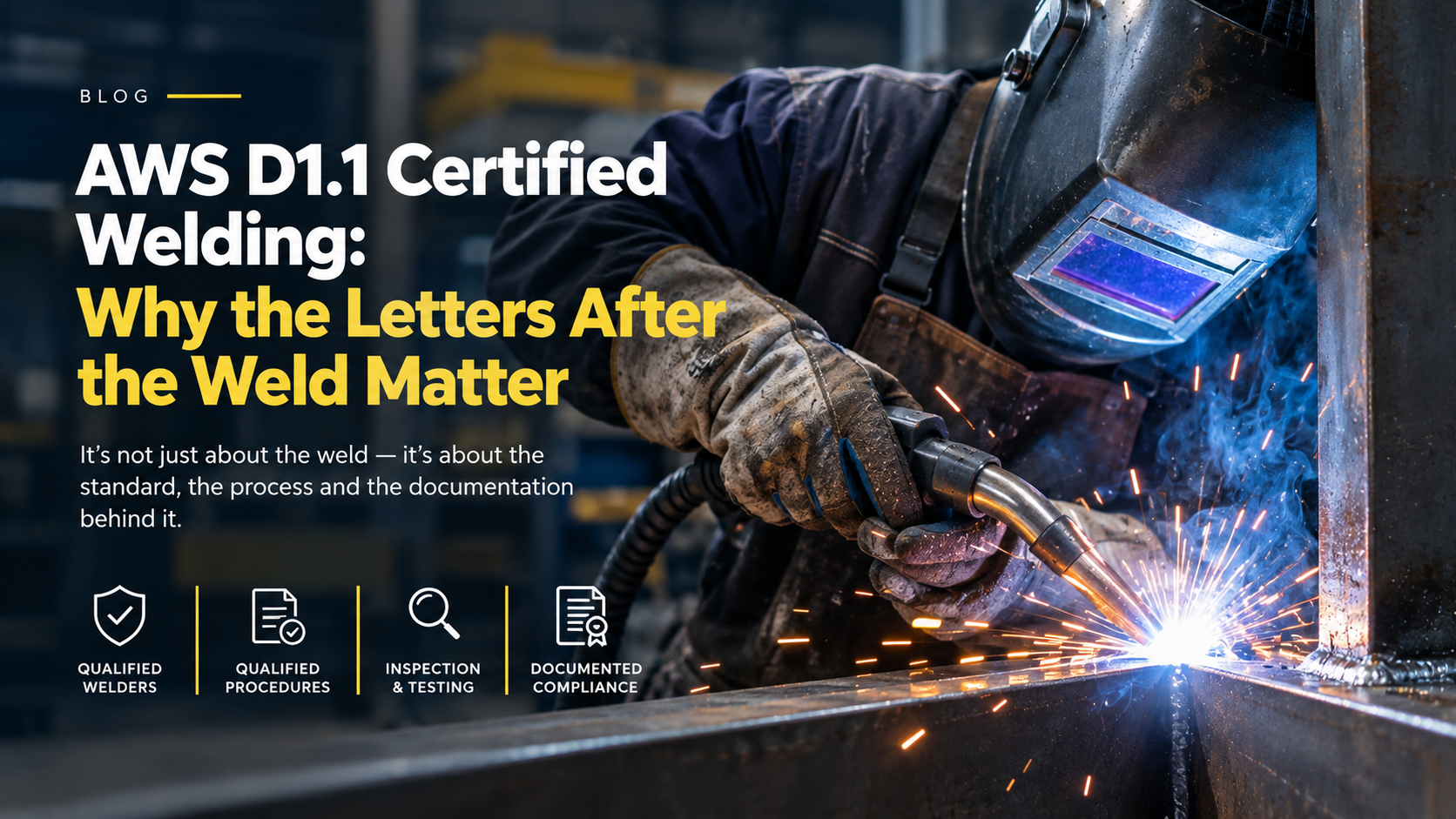
“Certified welding” shows up on almost every fabrication shop's website. It's a phrase, not a credential, until there's a standard attached to it. Ours is AWS D1.1 — the American Welding Society's structural welding code, and the one most often specified when a weld actually has to carry load.
D1.1 governs structural steel welding — the kind of joint that carries load, not just holds a panel together. It sets requirements for welder qualification, procedure qualification, weld inspection, and acceptance criteria. A weld that's D1.1 certified has been made by a qualified welder, following a qualified procedure, to a documented standard — not just welded until it looked right and passed a visual glance.
That distinction — welder qualification versus procedure qualification — matters more than it sounds like it should. A welder can be individually certified to a process and position. A weld procedure specification (WPS) can be separately qualified for a given joint type, material, and thickness. D1.1 requires both to be documented and on file, which means the certification isn't just about who's holding the torch — it's about whether the whole process, from procedure to execution to inspection, has been verified.
On structural or load-bearing jobs, an engineer isn't just asking “is it welded.” They're asking whether the joint was made to a code that can be verified, documented, and defended — because a weld failure on a structural component isn't a cosmetic issue, it's a liability issue. Specifying D1.1 shifts that risk from “we assume it's fine” to “here's the procedure and the qualification that says it's fine.”
This matters most on the projects where a weld failure would be expensive in ways beyond the part itself: infrastructure components, structural supports, anything where a downstream failure means a safety incident or a liability question, not just a warranty claim. On those jobs, the paperwork behind the weld is as important as the weld itself — it's what lets an engineer sign off on a design with confidence instead of an assumption.
If a vendor's site says “certified welding” without naming a standard, ask which one. Ask whether it's the welder that's certified, the procedure, or both. Ask whether they can produce the documentation on request — welder qualification records, procedure specifications, inspection records. “Certified” without a code number attached is a marketing word doing the job of a spec.
The letters matter because they're checkable. That's the whole point — a standard you can look up, a procedure you can request, and documentation that exists whether or not you ever ask to see it.
